
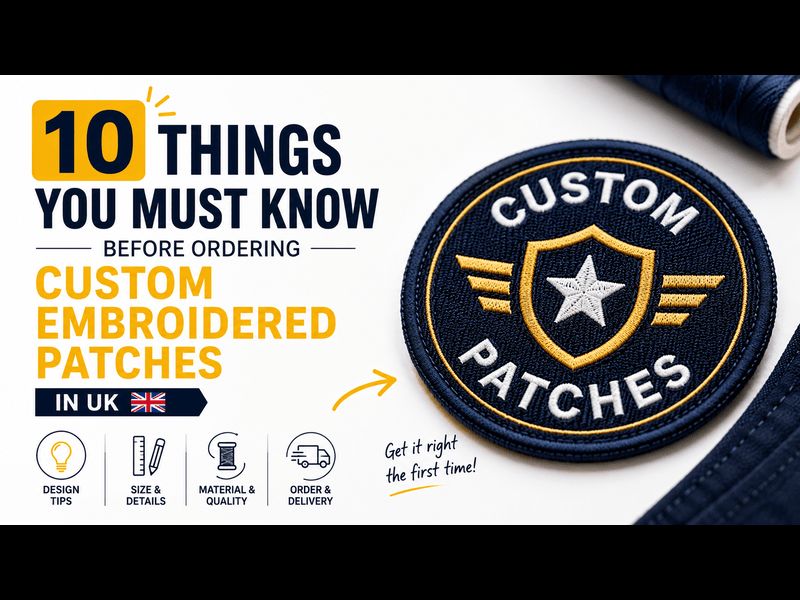
10 Things You Must Know Before Ordering Custom Embroidered Patches in UK
Taking a few minutes to ask the right questions before production begins usually leads to a better result. It also helps you avoid misunderstandings with the manufacturer and ensures the finished patches match your expectations.
A patch often looks simple once it arrives, but getting to that finished product involves dozens of small decisions. The artwork, thread colours, backing, border style and fabric all affect how the final patch will look and perform.
Most of the buyers only realise this after placing an order. But by then, changing a design or correcting a mistake can delay production or increase costs.
Here are ten questions worth asking before approving your next order.
10 Important Questions You Should Always Ask Your Manufacturer
Finding the best custom patch maker only feels like a dream for many patch lovers. This is because they neglect the need for assessing some key points during their manufacturer search process.
Make sure to ask the following questions before finalising the service provider.
1. Where Will These Patches Be Used?
The first question should always be about the purpose of your patch.
A patch designed for a school uniform has very different requirements from one created for a promotional event.
This is why you need to think about:
- whether the patch will be washed regularly
- whether it will be attached permanently
- whether it needs to withstand outdoor conditions
- how often it will be worn
The answers influence almost every production decision ahead and will allow you to discuss the features needed for your patch in more detail.
2. Which Backing Option Fits the Job?
Many people simply ask for iron-on backing because it sounds convenient, but it isn’t always the best choice in all cases.
Iron-on patches work well for many garments, but uniforms and heavy outdoor clothing often benefit from sewn borders for extra durability.
Hook-and-loop backing can also be a more practical choice when patches need to be removed or replaced.
A good manufacturer will explain to you the advantages of each option instead of recommending the same backing for every order.
3. Will My Design Work as Embroidery?
Most of the digital logos struggle to convert neatly into thread.
This is why very fine text and complicated shading may need adjustments before production begins.
You should always ask to see whether any elements need simplifying.
Small changes made during digitising often improve the finished patch rather than reduce its quality.
A manufacturer who discusses these details before production usually saves customers from disappointment later.
4. What Size Will Show the Design Clearly?
No proper size is better, neither bigger nor smaller.
Your custom embroidered patches should be large enough for important details to remain visible without becoming awkward to wear.
So if your design contains text and multiple colours, ask whether increasing the size slightly would improve clarity.
Experienced embroidery specialists can often recommend dimensions based on previous production work instead of just relying on guesswork.
5. Can I Review a Digital Proof?
Approving a proof should never feel like a formality. This is why you should take your time and get the peace of mind regarding your sample.
Here is what you need to check:
- Letter spacing
Presence of small lettering might need adjustments to remain readable after stitching.
- Thread colours
Colours can appear slightly different in embroidery than on a computer screen.
- Border shape
The finished outline should match the intended design rather than relying on automatic settings.
- Overall proportions
Designs sometimes require small layout changes once converted into stitches.
Looking carefully at the proof often catches issues that would otherwise appear on every finished patch.
6. How Many Thread Colours Are Included?
Embroidery thread often creates a different effect from printed ink.
Modern machines can produce impressive detail and designs with dozens of colour changes, which can become more expensive or slightly more complex to manufacture.
You should ask whether similar shades can be combined without changing the overall appearance.
Sometimes, even reducing unnecessary colour variation will produce a cleaner-looking patch.
7. What Border Style Will Suit the Design?
A lot of customers focus entirely on the artwork while overlooking the border, but the edge influences both appearance and durability.
- Merrow borders create a traditional raised edge and suit classic shapes such as circles and shields.
- Laser-cut or stitched borders provide greater flexibility for unusual outlines or modern logo designs.
Choosing the right border usually depends on the artwork rather than personal preference.
8. How Long Will Production and Delivery Take?
Lead times can vary depending on the seasonal demand and the level of customisation involved.
You should ask what each stage of the process looks like instead of asking for the arrival times. Find out how long is normally needed for artwork approval, digitising, quality checks and shipping.
9. Is There a Minimum Order Quantity?
Some suppliers specialise in large commercial runs, while others are happy to produce smaller batches for custom patches UK.
Understanding the minimum order helps with budgeting and future planning. If you expect to reorder the same design later, ask whether your embroidery file will be stored.
Reusing an existing digitised design can help you reduce both production time and setup costs on future orders.
10. What Happens If There’s a Problem?
There is a chance of mistakes occurring even if you plan things carefully.
So before confirming your order, you should ask how the supplier handles issues such as production errors or damaged deliveries.
A reputable company should explain:
- How quality is checked before dispatch
- All the charges associated ( no hidden costs)
- What happens if the finished patches differ from the approved proof
- Whether replacements are available if a manufacturing issue occurs
- How customer support can be contacted after delivery
The answers will tell you a lot about the business and if they are a reliable choice or not.
FAQS
- Are embroidered patches suitable for outdoor clothing?
Sure, but only when using appropriate materials and backings. The patches for jackets, uniforms, or any other outdoor clothes need to be durable enough.
- How many rounds of revision do I need to complete prior to patch design approval?
The vast majority of suppliers will offer you at least one digital proof prior to starting the manufacturing process. Any necessary modifications can be discussed before the approval of the artwork because they are much easier to implement at this stage than after the start of embroidery.
- Is it possible to remake an old badge?
In most cases, yes. It is possible to recreate your old patch with the help of the manufacturer by using the photograph or a physical sample.
Final Thoughts
The most successful patch design is never an accidental one; it happens through planning and communication with the manufacturer. An excellent patch design is the one that looks nice when it comes out of the shipping package and also performs well after many months or even years of continuous use. Discussing all the necessary issues during the consultation before placing the order will help to make sure the final product is up to the mark.

I am Emma Wilson. I love sharing ideas about custom designs and creative projects. I write simple guides, tips, and helpful articles about embroidered patches to help people find new ideas and learn more about patch designs.